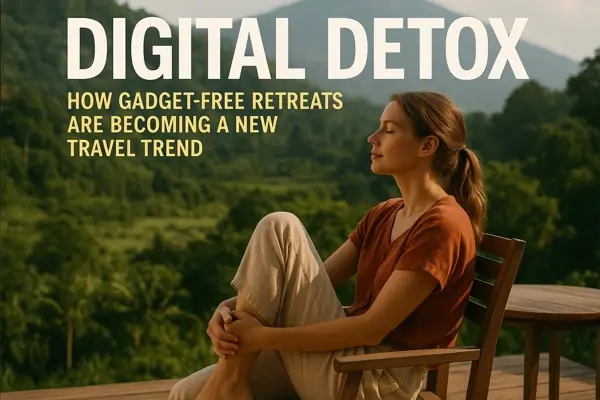
Just a decade ago, few travelers considered switching off their phones on vacation. Today, the idea of a digital detox has become one of the most in-demand directions in the travel industry. Gadget-free retreats — places where the internet and social media are replaced by silence, meditation, and contact with nature — are now a hit among city dwellers tired of constant notifications.
Why We’re Tired of Screens
Studies show that the average person spends between 4 and 6 hours a day on their smartphone. Add work video calls, messaging apps, endless news feeds, and social media, and it turns out there’s hardly any free space left for oneself. Psychologists warn that constant “online vigilance” leads to burnout, anxiety, and sleep disturbances.
It’s no surprise that more and more people are seeking a chance to spend time without gadgets. The idea of “digital fasting” is no longer exotic — it has turned into a new form of tourism.
What Digital Detox Retreats Are
The formats vary: from yoga centers in the mountains to eco-hotels on the coast where the internet is intentionally switched off. Programs include meditation, breathing practices, nature walks, cooking classes, and art therapy. The key principle is the same: no phones, laptops, or televisions.
Often, guests hand over their devices at check-in and only get them back at the end of the program. For many, the first 24 hours are the hardest: the habit of checking a screen “automatically” is hard to resist. But within a couple of days, participants report lower anxiety and better sleep.
Geography of Disconnection
America offers secluded mountain retreats in Colorado and Montana, as well as coastal programs in California. These emphasize contact with wilderness, hiking, and mindfulness sessions.
Europe offers eco-retreats in the Alps, Tuscany, or along the Portuguese coast. These focus on a mix of nature, healthy food, and mindfulness practices.
Asia has long been a magnet for digital detox travelers. Thailand, India, and Bali lead the way with numerous retreat centers, often combining yoga and Ayurvedic practices.
Who Needs This
Business leaders and executives living in 24/7 mode and feeling overloaded with information.
Creative professionals seeking inspiration without the pressure of media.
Families who want to restore real communication without screens in the way.
Young people, increasingly aware of the harm of endless scrolling.
The Economics of Silence
The market for digital retreats is growing by 10–15% annually. Tour operators now sell “silence packages” priced from a few hundred to several thousand dollars. Paradoxically, limiting access to the internet has itself become a commercial product people are willing to pay for.
What This Experience Gives
Participants note that after returning home, they perceive time differently, reach for their phones less often, and focus better on tasks. Of course, the effect isn’t always long-term — the digital world quickly pulls people back. But even a short break shows that life without constant notifications is possible.
In Conclusion
Digital detox retreats are more than just a passing trend — they are a response to the real challenges of our time. As the world accelerates and technology penetrates every aspect of life, more people are searching for islands of silence. Traveling without the internet has become a luxury, and the ability to spend time alone with oneself is emerging as a new form of wealth.